
What is a Mature Minor?
As a young person matures towards their mid-teens their relationship with their psychological care naturally evolves to reflect their growing independence and autonomy. The therapeutic relationship is built upon trust and privacy, and as such, evolves with them. They inevitably reach an age in which they can begin to make their own decisions and give their own consent for their care, which is what we call being a “mature minor”.
In Australia, legal and professional standards can recognise a young person under 18 as a "mature minor" when they demonstrate sufficient understanding and intelligence to make informed decisions about their own psychological care. This is a routine, clinical determination by the treating clinician, based on their ongoing knowledge of the young person, developed over the course of treatment. It is a normal, positive milestone in the psychological care of adolescents, one that strengthens the therapeutic relationship by respecting the young person’s privacy and right to growing autonomy.
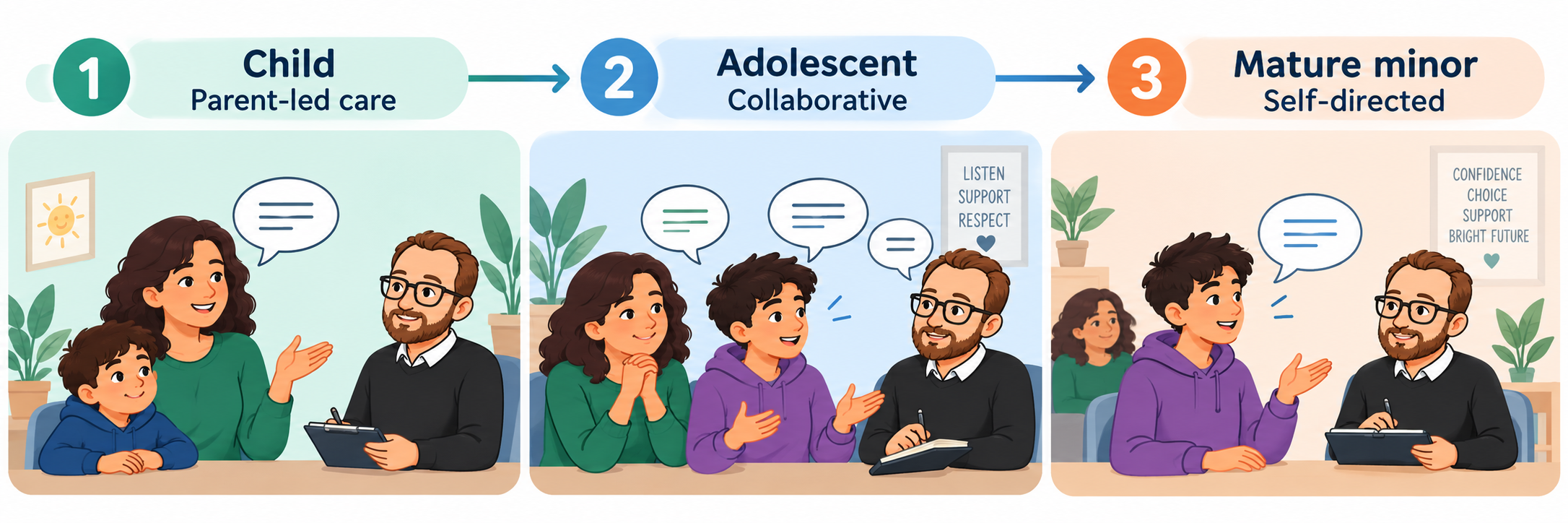
What changes?
A mature minor holds the same client rights as an adult for their psychological care. The common thread across all of these changes is that the young person is involved, included and in control of all aspects relating to their care. These changes include:
Consent to treatment / services: A young person provides their own informed consent to all aspects of psychological services, including the type, frequency and focus of therapy and services, treatment/assessment goals and decisions to continue, pause or cease treatment / services.
Consent for third-party involvement: Any involvement of a parent, family member or other professional in a young person's care (beyond administration, scheduling and payments), including attending sessions, receiving updates or requesting information, requires their knowledge and consent.
Privacy and information rights: A young person's personal information is confidential to them. Disclosure to parents or others requires their consent. Any correspondence or documentation relating to their care is recorded on their clinical file and they are to be informed of it and to request access to it.
These changes do not affect the psychologist's professional and legal obligations to act where there is a genuine risk of harm to the young person or others. This determination may also be reviewed where circumstances change or complexity increases beyond the young person's capacity to make informed decisions independently.
How to stay involved in a young person’s care
Parental involvement remains welcome and important in therapy. It should come through a willing and transparent partnership with the young person and yourself. In addition, confidentiality is what makes therapy work. Without it, young people tend to disengage and share less. The following are ways that parents can be involved whilst respecting a young person’s privacy and growing autonomy.
Click on the following 3 pathways to show a range of options to navigate these changes:
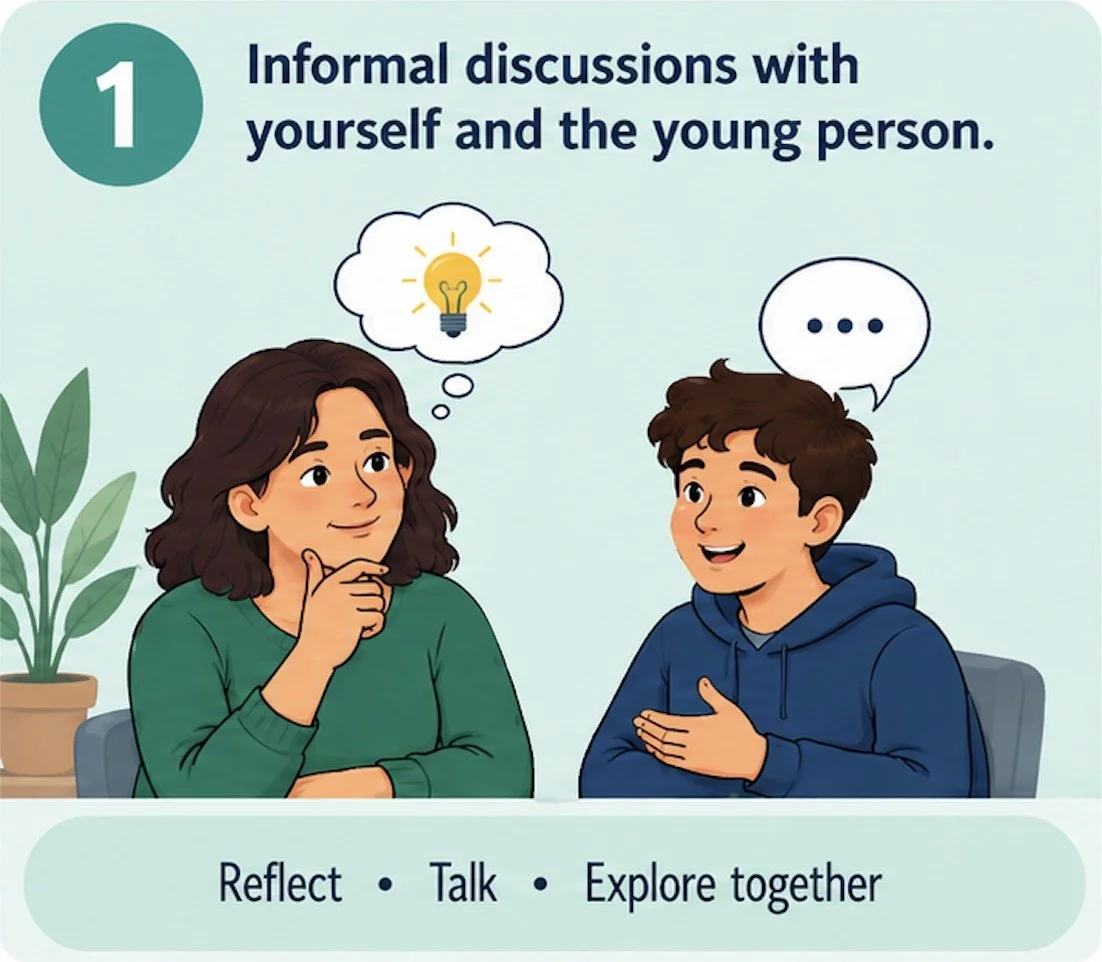
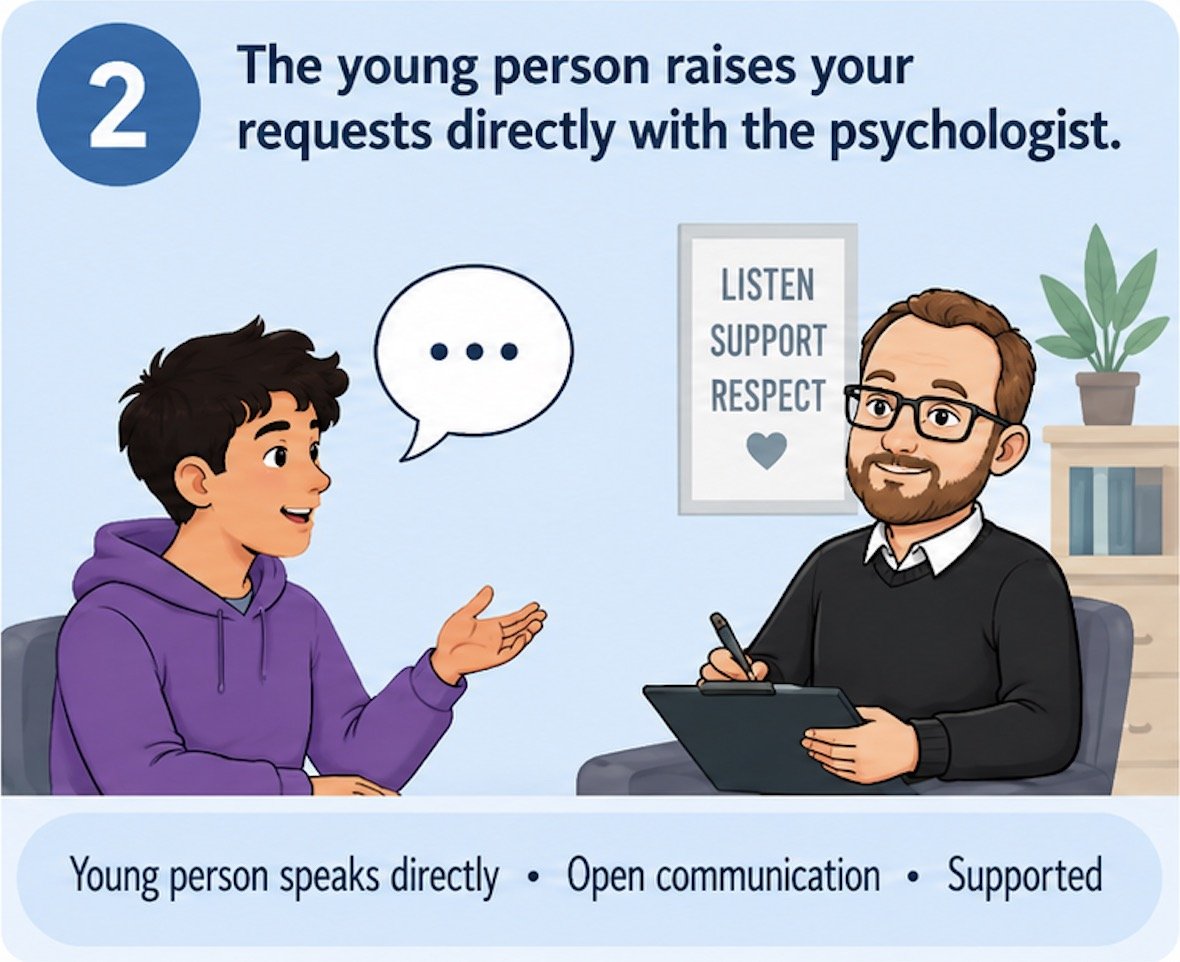
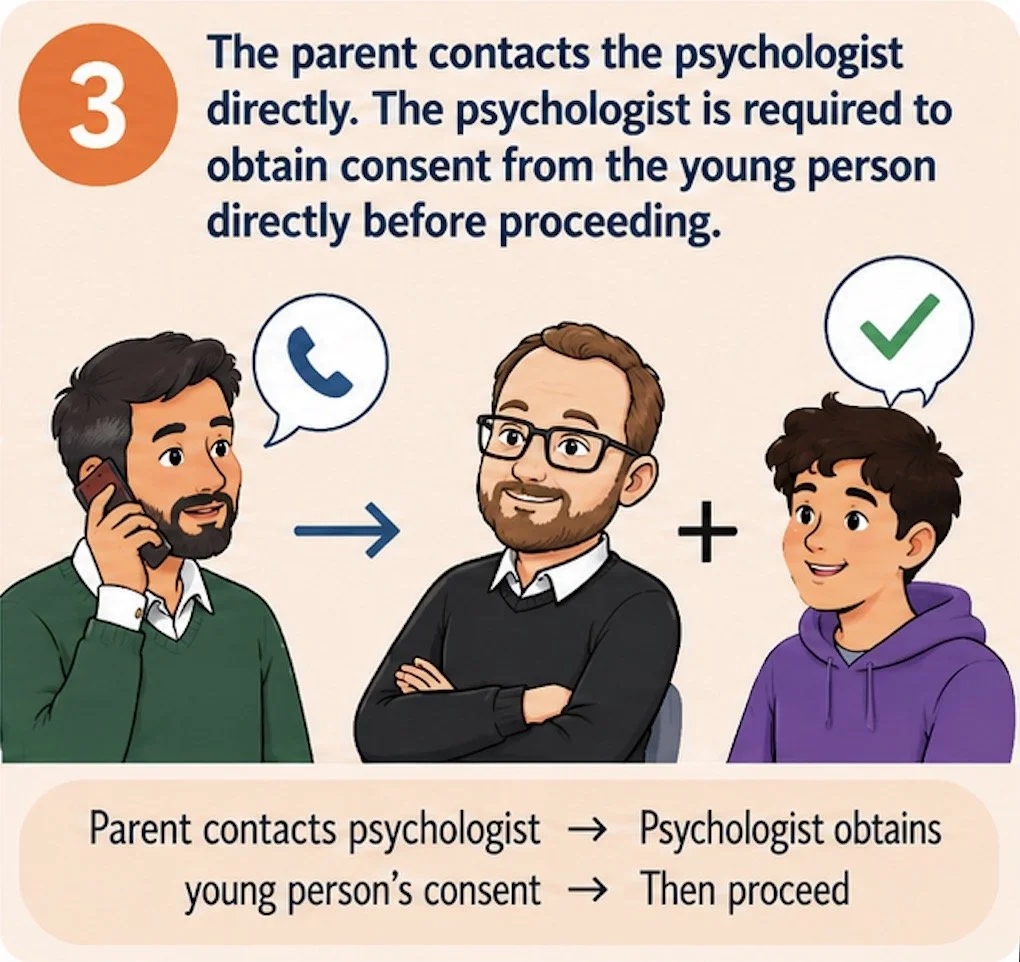
Pathway 1)
Informal discussions with yourself and the young person
Talk with the young person at home.
Casual conversation about their week, their mood or how therapy is going is one of the most valuable ways to stay involved. If you observe improvements or difficulties, offer insights gently and non-judgmentally. You don't need to know clinical content to support them and the young person can volunteer information if they feel comfortable.
Ask them how you can best help them.
Most young people welcome administrative help by default (scheduling, reminders, payments, etc.), but asking them how you can support them in their therapy can be empowering. Respect which areas they would like help with and which areas they do not.
Ask them to raise something in session.
If there's something you'd usually mention to the psychologist yourself, ask whether they'd bring it up themselves. This keeps them in control of their care. You can debrief with them afterwards if they're open to it, but if they'd rather not share what came up, that's their call.
Pathway 2)
The young person raises your requests with the psychologist
Rather than requesting things yourself, raise the idea with the young person first. If they agree, they can bring the request directly to the psychologist. This keeps the young person in the loop and in control of their own care.
Join part of a session (Join the first or last 5-10 minutes of a session for a check-in)
Mention it to the young person and see whether they'd like to arrange it with the psychologist. They decide what they're comfortable sharing and the arrangement is made directly between them and the clinician. They can raise it directly with the psychologist.
Request a written or verbal update (a general progress update / parental strategies)
In the young person's presence, at the start or end of a session, is best for transparency. Talk it over with the young person, and if they're comfortable, they can raise it with the psychologist who'll work out with them what they're happy having shared and what they'd rather keep private.
Contact the psychologist between sessions
Raise your requests with the young person, which is best for transparency. If they feel comfortable to do so, they can then contact the psychologist on your behalf. Detailed clinical or sensitive information is not appropriate to share via email. Keep in mind that any contact will be noted on the clinical record.
If the young person is not comfortable taking a request to the psychologist, it might be helpful to gently explore why. There are sometimes good reasons and sometimes reasons worth working through together. They do have the option to decline which should be respected.
Pathway 3)
The parent contacts the psychologist directly
The psychologist is required to obtain consent from the young person directly before proceeding
You are welcome to contact the psychologist directly. This pathway involves some or all of the following steps, depending on the nature of the request:
Reviewing & responding to your request,
Contacting the young person to discuss the request, their preferences and obtain their informed consent,
Following up with you on the outcome and discussing your requests,
Following up with the young person upon conclusion,
Notating the communication and consent process on the clinical record.
Please be aware the young person may decline and that all communications become part of their clinical record.
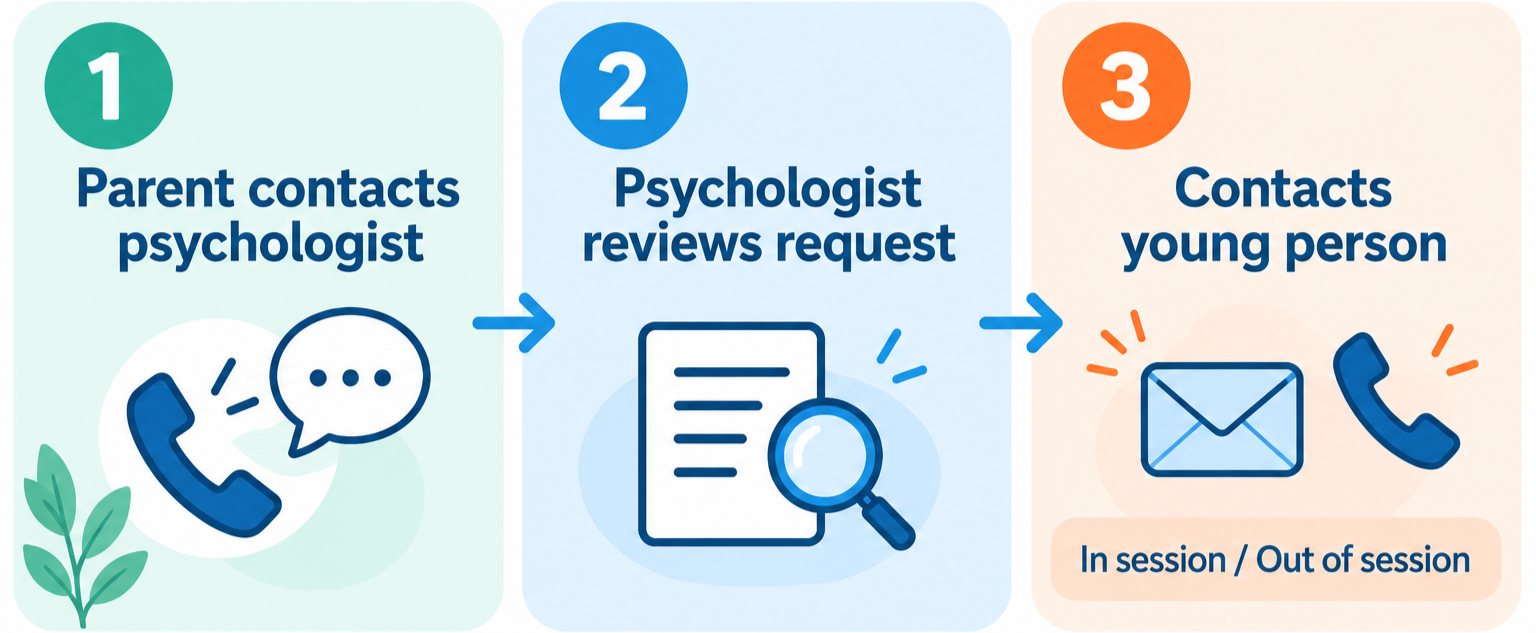
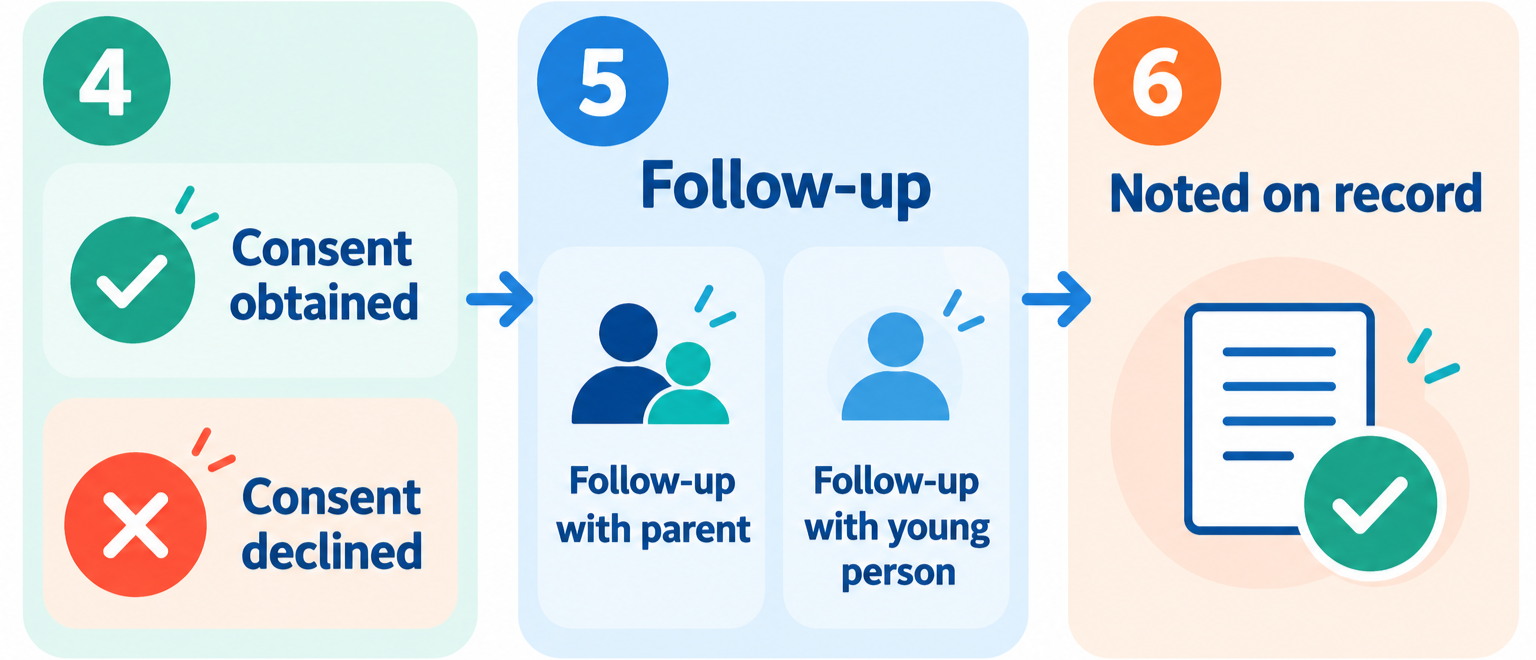
This process often takes time and fees apply for any out-of-session work. Steps that can be addressed in a standard session with the young person do not attract an additional fee. Steps that require out-of-session work are billed at $75 per 15 minutes (in 15-minute increments). These additional fees are not covered by Medicare and are still billable if the young person declines consent. Where possible, the psychologist will look to minimise out-of-session steps. You will be advised of any anticipated fees before work begins.
Join part of a session (Contact the psychologist directly)
Join the first or last 5-10 minutes of a session for a check-in.
Request a written or verbal update (Contact the psychologist directly)
Shared in the presence of the young person is recommended for transparency, but private sharing is possible with the young person’s consent. Contact the psychologist directly.
Contact the psychologist between sessions(Contact the psychologist directly)
If you'd like to raise something directly, it’s best for transparency to let the young person know first. Keep in mind that the psychologist is required to tell them what was discussed and all information becomes a part of their clinical record. Detailed clinical or sensitive information is not appropriate to send via email.
Private consultation with the clinician (Contact the psychologist directly)
In rare circumstances a private session with the clinician may be deemed appropriate. However, in most cases, transparency and inclusion of the young person is most appropriate and recommended.
Professional obligations and the integrity of therapy
These are mandatory professional standards, not personal choices.
The framework described on this page is not a personal policy. It reflects mandatory obligations under the AHPRA Psychology Board of Australia Code of Conduct and is supported by the APS Professional Practice Guidelines. These are enforceable professional standards that apply to every registered psychologist in Australia.
We understand this may represent a genuine shift for many families. For parents who are accustomed to having full and direct access to their child's clinical care without needing the young person's involvement, being asked to work through the young person can feel counterintuitive and frustrating, even if parental involvement is coming from a place of genuine love and concern.
These obligations also protect the psychologist's objectivity and impartiality.
A less obvious aspect of these obligations is that they also exist to protect the psychologist's objectivity and impartiality. The Code requires psychologists to avoid conflicts of interest, including any situation that could reasonably be perceived to compromise their impartiality and to prioritise the best interests of the client above all other relationships. When a parent shares clinical concerns or requests information outside of the consent framework, even with good intentions, it places the psychologist in a position where their objectivity, and the young person's trust in it, is put at risk. This is why unsolicited clinical contact without the young person's involvement is not simply inconvenient. It creates a professional obligation to act, document and resolve.
It may not be immediately obvious, but when a parent requests clinical information about their young person without that young person's consent, they are, often unintentionally, asking the psychologist to breach a legal and ethical obligation. This is serious. The psychologist's refusal is not a personal choice. It is compliance with the same legal framework that protects every client in their care.
Persistent disregard of these boundaries can harm the young person's therapy.
When the boundaries of this framework are persistently disregarded, the consequences extend beyond administrative inconvenience. Repeated pressure on the psychologist to act outside these boundaries can fracture the young person's trust in the therapeutic relationship itself, sometimes irreparably. A young person who no longer believes their privacy is protected, or who feels that the space meant for them has been compromised, may disengage from therapy entirely.
Separately, where a pattern of boundary disregard creates an adversarial dynamic between a parent and the clinician, the psychologist must also consider whether they can continue to provide the objective, impartial service the young person is entitled to. A therapeutic relationship that has become caught in external conflict and tension is no longer a safe or neutral space, and continuing under those conditions risks harm in itself.
In serious cases, supervision and cessation of services may be required.
In those circumstances, the psychologist is required to seek professional supervision, a mandatory regulatory step, not a unilateral personal decision, and may ultimately need to consider cessation of services, managed carefully and in the young person's best interest. This outcome is not what anyone wants. It is raised here as an honest account of where persistent boundary disregard can lead and as a reminder that any action taken by the psychologist in these circumstances is an attempt to preserve the integrity of treatment for the sake of the young person.
The goal of this framework is to keep the door open for the young person and for the family around them. Respecting it is the most direct way to stay involved.