

WISC-V
What is the WISC-V? The fifth edition of the Wechsler Intelligence Scale for Children is a standard assessment used by psychologists to understand how a child thinks, learns and solves problems. Tasks may involve solving puzzles, remembering information, working with numbers, spotting patterns and completing activities under time limits. The results help explain a child’s learning strengths and areas that may need extra support, especially in a school setting.
What does it show over time? While IQ scores (like those estimated by the WISC–V) tend to stay relatively stable over time compared to others the same age, children can still develop skills and strategies that help them thrive academically and personally. Research shows that higher cognitive scores are linked to better outcomes in areas like academic achievement, job performance, and problem-solving in daily life—but they are just one piece of a much bigger picture when understanding a child’s needs and potential
What does it NOT measure? It’s also important for families to understand what the WISC–V does and does not measure. It doesn’t assess creativity, emotional intelligence, motivation, social skills, or talents in areas like music, art or sport. These are valuable parts of a child's overall potential and success in life, but they aren’t captured in this type of testing.
Full Scale IQ (FSIQ) & Primary Indexes
The WISC–V includes five main indexes: Verbal Comprehension, Visual Spatial, Fluid Reasoning, Working Memory and Processing Speed, each reflecting a different area of thinking and problem-solving – All combining to what is called a Full-Scale IQ (FSIQ).
Full-Scale IQ: The Full-Scale IQ is a summary score that reflects a child’s overall thinking ability, based on performance across all five indexes. It gives a general sense of how a child learns, solves problems, and processes information compared to others the same age. However, many children have uneven profiles, so it’s often more helpful to look at the individual index scores to understand specific strengths and challenges, rather than relying only on the FSIQ
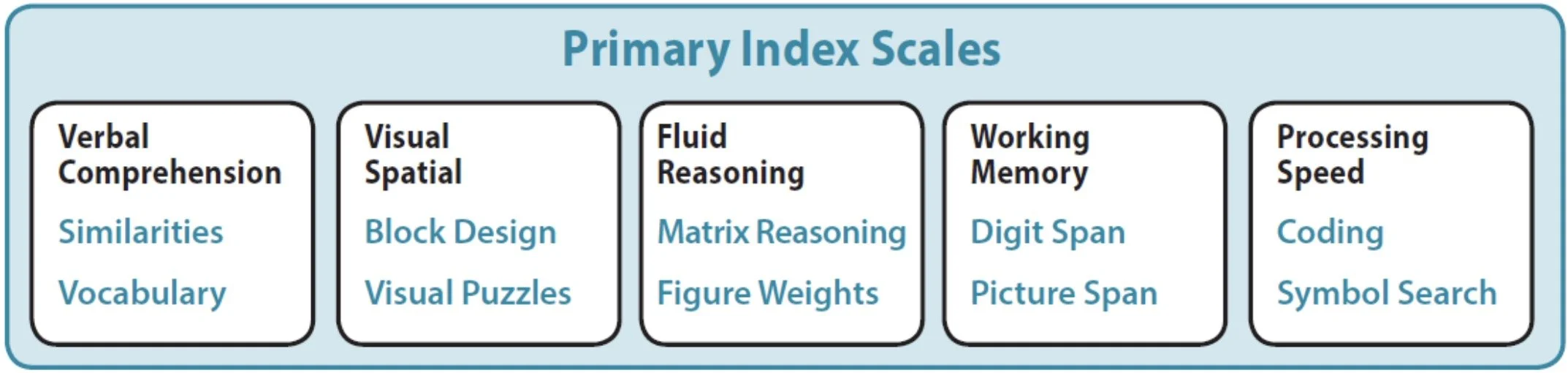
Verbal Comprehension (VCI): This measures how well a child understands language, uses words to express ideas, and grasps verbal concepts. Subtests that make-up the VCI include Similarities and Vocabulary.
At school, this shows up in activities like reading comprehension, following classroom instructions, answering questions, and participating in discussions.
At home, it may affect how easily a child communicates their thoughts, follows spoken directions or joins in conversations
Visual Spatial (VSI): This assesses a child’s ability to understand visual details, see how parts fit together, and work with shapes and designs. Subtests that make-up the VSI include Block Design and Visual Puzzles.
At school, it can be seen in tasks like geometry, drawing diagrams, reading maps, or copying from the board.
At home, it might show up in things like building Lego, assembling furniture or doing jigsaw puzzles.
Fluid Reasoning (FRI): This reflects how well a child can solve new problems using logic and pattern recognition, especially when the solution isn’t something they’ve been directly taught. Subtests that make-up the FRI include Matrix Reasoning and Figure Weights.
At school, it helps with subjects that involve problem-solving like maths and science, and with understanding abstract concepts.
At home, it can show in how a child approaches unfamiliar tasks, works things out for themselves, or adapts when routines change.
Working Memory (WMI): This looks at how well a child can hold and use information in their mind over short periods. Subtests that make-up the WMI include Digit Span and Picture Span.
At school, this is important for multi-step tasks like mental arithmetic, taking notes while listening, or remembering instructions.
At home, it can affect how well a child follows through on tasks like “Go upstairs, get your shoes, and bring down your bag,” or keeps track of steps when doing chores.
Processing Speed (PSI): This measures how quickly and accurately a child can carry out simple, routine tasks, especially under time pressure. Subtests that make-up the PSI include Digit Span and Picture Span.
At school, it can influence how fast a child completes worksheets, keeps up with classroom pace, or finishes exams.
At home, it may affect how long it takes them to get through things like getting dressed, packing their bag, or doing homework.
Ancillary Indexes
Ancillary indexes are additional scores available in the WISC–V that provide more detailed insight into a child’s thinking and learning. They aren’t always included in a standard assessment, but psychologists may use them when a more focused understanding is needed — for example, when a child shows an uneven profile, has a known learning difficulty or when standard scores don’t fully explain what’s happening day to day.
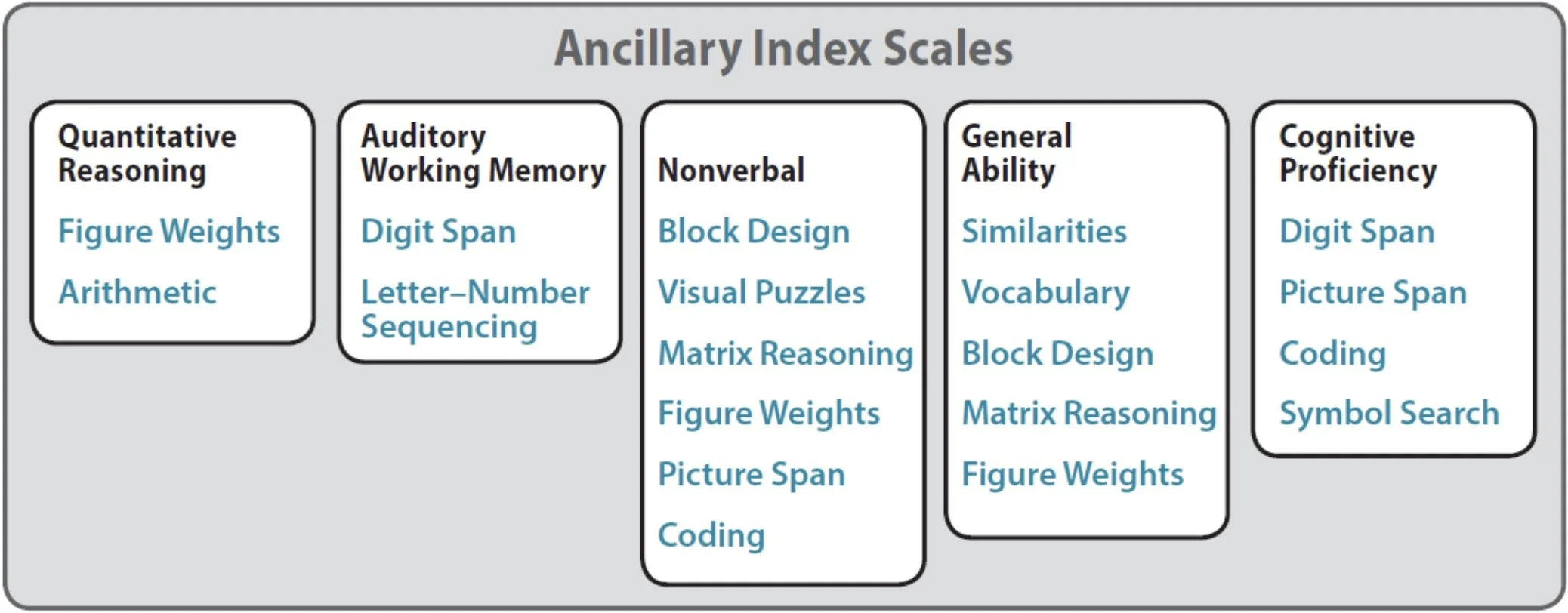
The General Ability Index (GAI) is an optional score on the WISC–V that provides a summary of a child’s reasoning and thinking ability by focusing ONLY on tasks that involve verbal comprehension (VCI), visual–spatial skills (VSI) and fluid reasoning (FRI). It excludes working memory (WMI) and processing speed (PSI).
The GAI is particularly useful when a child shows strong reasoning abilities but has difficulties with attention, mental efficiency, anxiety or timed tasks, as it offers a fairer estimate of their core intellectual strengths.
The GAI is made up of subtests from the Verbal Comprehension Index (Similarities and Vocabulary), the Visual Spatial Index (Block Design), and the Fluid Reasoning Index (Matrix Reasoning and Figure Weights).
Cognitive Proficiency Index (CPI): is an additional score available on the WISC–V that reflects how efficiently a child can take in, hold, and work with information. It focuses on the mental skills needed for learning and carrying out everyday tasks, particularly those that rely on attention, short-term memory, and speed.
It is often useful when a child shows average or strong reasoning abilities but struggles to keep up with the pace of learning, follow instructions, or manage multi-step tasks. The CPI helps highlight how well a child can process simple information quickly and accurately, and can be especially informative in cases where the Full-Scale IQ doesn’t fully explain the child’s learning profile.
The CPI is made up of subtests from the Working Memory Index (Digit Span and Picture Span) and the Processing Speed Index (Coding and Symbol Search).
Subtests
Similarities (VCI) – The child is asked how two things are alike (e.g. “How are a banana and an apple alike?”). This measures verbal reasoning and the ability to form abstract connections.
Vocabulary (VCI) – The child defines words spoken by the examiner. This assesses word knowledge and verbal concept formation.
Block Design (VSI) – The child is shown a pattern and asked to recreate it using red-and-white blocks within a time limit. This assesses visual–spatial processing, visual-motor coordination and problem-solving skills.
Visual Puzzles (VSI) – The child is shown a completed puzzle and must choose the correct pieces (from multiple options) that would go together to make that puzzle. This requires mental rotation, spatial reasoning and visual analysis without physically manipulating objects.
Matrix Reasoning (FRI) – The child looks at a series of visual patterns with one part missing and selects the image that completes the pattern. This assesses non-verbal abstract problem-solving, inductive reasoning and visual-spatial thinking.
Figure Weights (FRI) – The child is shown a scale with shapes and must choose the option that balances it correctly. This tests quantitative and analogical reasoning, as the child needs to understand balance, weight and equivalency concepts.
SUPPLEMENTAL: Arithmetic (FRI) – The child solves verbally presented word problems involving basic maths concepts (e.g. “If you have 3 apples and buy 2 more, how many do you have?”). This assesses mental maths, quantitative reasoning, attention, and working memory.
Digit Span (WMI) – The child listens to a series of numbers and repeats them back in the same order (Digit Span Forward), in reverse order (Digit Span Backward), or in a specific sequence (Digit Span Sequencing). This assesses auditory attention, short-term memory, and mental manipulation.
Picture Span (WMI) – The child is shown a series of pictures, then asked to select them in the same order from a larger group. This evaluates visual working memory and the ability to retain and reproduce visual information.
SUPPLEMENTAL: Letter–Number Sequencing (WMI) – The child hears a mixed list of numbers and letters, then repeats them back with numbers in numerical order and letters in alphabetical order. This tests auditory working memory and complex sequencing skills.
Coding (PSI) – The child matches symbols to numbers using a key, filling in as many as possible within a time limit. This assesses visual-motor coordination, attention to detail, and the ability to work quickly and accurately on routine tasks.
Symbol Search (PSI) – The child looks at a pair of target symbols and scans a row to determine if either symbol appears. It tests visual scanning, discrimination, and processing speed with minimal writing demand.